
Discours intonatio
It is a functional approach of phonetics and phonology that analyzes naturally
occuring discourse in everyday speech. It analyzes meanings and the
negotiation of meaning, or the choices we make on a moment-by-moment
basis, which are situationally specific depending on the context.
CONTEXT-DECISIONS-CHOICES. -> Basis of the theory.
●
Wha i intonatio?
Intonation has to do with changes in pitch. Different languages have different intonation
patterns. Intonation choices do not change the meaning of the word, but in some languages
if you produce a falling tone (for example) you might produce a change in the lexical
meaning of the word, but not in English.
The minimum unit of intonation is the tone unit.
According to Brazil, there are four subsystems that make up the system of
intonation.
Prominence
Tone
Key
Termination
Whic choice d w mak a regard ton unit?
● Prominence: When we produce a tone unit we select which information to highlight
or make prominent based on informativeness, which is the assessment that we make
as regards how much information a word is providing in that specific
communicational event. If we think that this word is adding valuable information to
the communicative context, then we highlight it; if it is not, then we make it
non-prominent.
● Tones: are changes in pitch movement. They have a meaningful load regarding
informativeness. We select which tones to produce regarding information status and
interpersonal relationships with the interlocutor.
● Key: has to do with pitch height.
● Termination: has to do with pitch height.
Wha i ton uni?
The minimum unit of intonation.
When we speak we produce utterances, which can be divided into minimum choices of
intonation which are called tone units.
Wha te of ton unit ar ther? Ar ther an difference amon the?
There are two types of tone units.
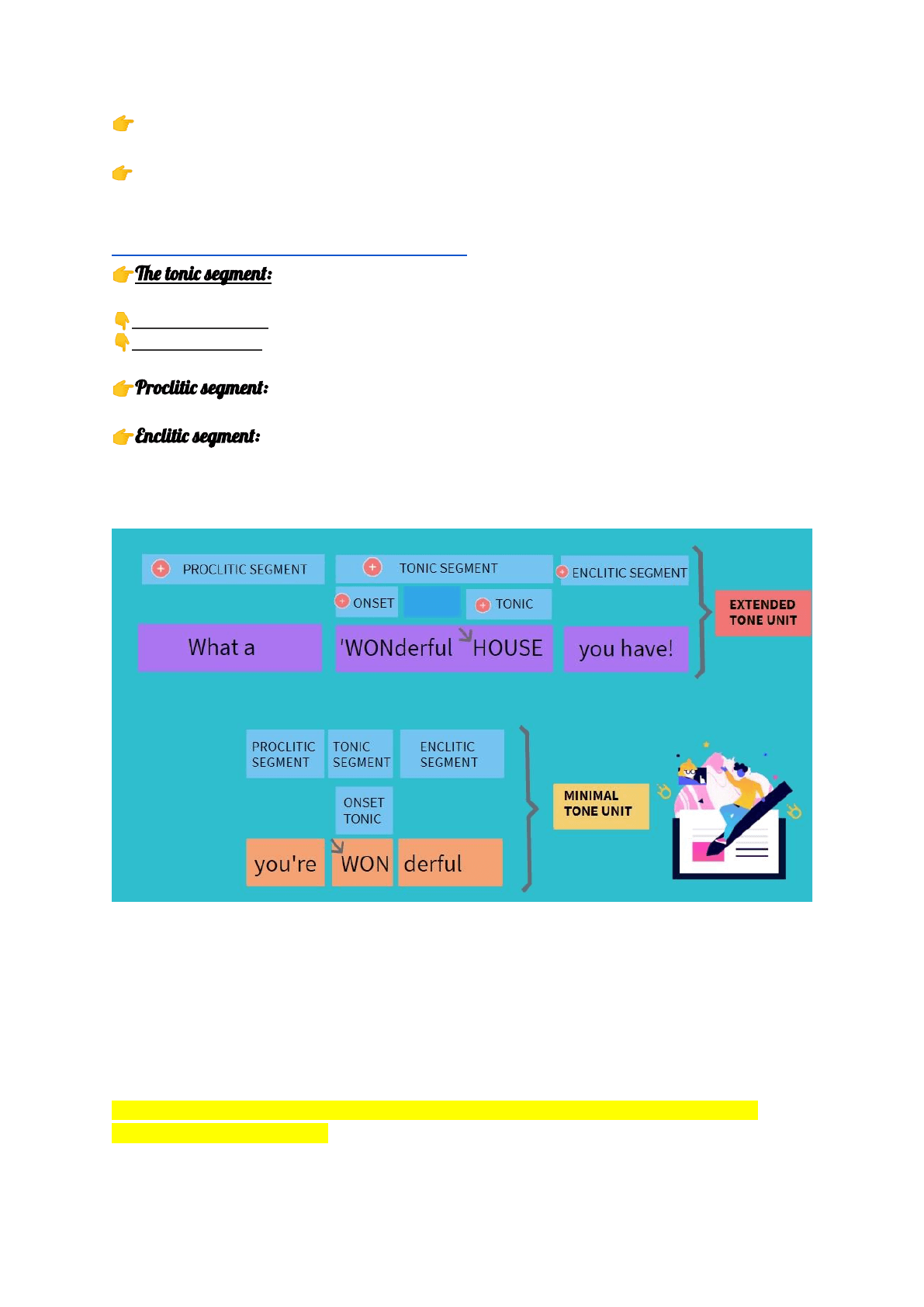
Extended tone unit: It has more than one prominent syllable, so the onset and
the tonic syllables do not coincide.
Minimal tone unit: It has only one prominent syllable, which is also the tonic.
Hence, the onset syllable and the tonic syllable coincide.
Wha ar th mai constituent of ton uni?
toni segmen: is the most important and compulsory element of the tone unit. It is
delimited by the first and last prominent syllables.
The onset syllable: The first prominent syllable in a tone unit. Key starts here.
The tonic syllable: The last prominent syllable in the tone unit.
An obligatory element of the
tone unit. Here occurs the major pitch movement. Tones and termination are found here.
Procliti segmen: The stretch before the beginning of the tonic segment. It does not contain
prominent syllables. This is an optional element.
Encliti segmen: The stretch that extends after the tonic segment. It does not contain
prominent syllables.
This is an optional element.
Wher i th ton uni doe th major pitc movemen occur?
In the tonic syllable, which is the last prominent syllable in the tone unit.
Prominenc
Wha i prominenc?
Brazil says that prominence is the name given to a property that is associated with a word by
virtue of its function as a constituent part of a tone unit.
Prominence is a linguistic choice available to the speaker independent of grammatical
structure and of word-accent
How ar th concept of informativenes an prominenc relate?
One depends on the other, the informativeness of a word in that specific communicative
context usually determines if it is prominent or not, but it is the speaker’s decision. Tus, the
speaker may choose to leave non-prominent pieces of information he assumes that are part
of the common ground or shared knowledge between him and his intended audience.
Ultimately, the speaker chooses whether to present information as shared or new.
How d w selec whic word t highligh?
We select which words to make prominent regarding informativeness, the information
load of the word, thus we select which words to make prominent depending on how
important we consider them to be in that specific communicative context. We make moment
by moment decisions as regards prominence.
Usually, lexical or content words attract prominence, and we usually do not make prominent
structure words.
However, we might make prominent structure words for contrast
For example:
“No, I said give it to her, not him”
A: “You didn’t do your homework”
B: “I did do my homework”
Wha i commo groun?
The concept of common ground cannot be reduced to new and shared information or
experience. When defining "common ground", Brazil suggests that it is useful to think of the
speaker seeing his world and the hearer's as overlapping. Thus, as they speak, language
users need to make decisions regarding whether to present what they say as shared or not.
For example, Brazil argues that by choosing the referring tone we speakers are making a
particular part of the message part of the shared common ground, and when choosing to
produce the proclaiming tone we are expecting to enlarge the common ground as result of
telling our interlocutors sth that they didn’t know.
Wha ar tone?
● Tones: are changes in pitch movement. They have a meaningful load regarding
informativeness. We select which tones to produce regarding information status and
interpersonal relationships with the interlocutor.
Proclaiming tones: falling, rise-fall
From the informational status point of view, we use proclaiming tones when we want to
provide new information.
From the role of status point of view, Proclaiming tones convey divergence/separateness
between speakers.
● Falling tone: from the point of view of role relationships and interpersonal meanings,
we may use a proclaiming tone in order to show that we disagree with the other
person. For example “↘well” “↘surely” “↘honestly”. To show divergence, distance or
that you are in a position of authority.
● Rise-fall tone: Brazil claims that when a speaker uses a rise-fall, they are
simultaneously adding information both to the common ground and to their own
store of knowledge. The information is marked as doubly new.
Referring tones: Rise, fall-rise
From the informational status point of view They mark the matter as part of the common
ground.
● Fall-rise tone: As regards social meanings, it conveys solidarity, convergence,
togetherness. We may use a fall-rise tone on items such as "frankly", "honestly", or
"to tell you the truth" to insinuate intimacy or solidarity.
Common ground assumptions | shared knowledge.
● Rising tone: Common ground assumptions | shared knowledge. Exert dominance
Level tone: for discourse planning, when we think about what we are going to say next. So
we buy time, so we usually say empty words, fillings or just some mumbling.
When we repeat things by heart.
Wha d w pa attentio t i order t mak ton choice?
Informativeness and interpersonal relationships.
Interpersonal relationships have to do with the roles the speaker plays in a conversational
exchange.
Apart from presenting information as shared or new, tone choices can also carry social
meanings of convergence / divergence, or solidarity / separateness.
Rol-relationship:
dominant speaker is the person who has the greater freedom in making
linguistic choices, can choose among the whole spectrum of tones to explode.
The rising and rise-falling tones are options which are usually exploited by dominant
speakers or by speakers who want to claim or assert dominance.
Dominant speaker -> Hierarchy, authority or claim dominance.
For example, use rising tones to signal authority or fall-rise tones to sound more friendly.
non-dominant speaker is the person who has limited choices among tones,
mostly between fall and fall-rise tones. Brazil states that when a passive speaker uses the
r/r+ system of tones he or she is claiming dominance. Sometimes this may be considered
inappropriate.
Ke
Pitch height or pitch level is produced through the whole tone unit
Key is relative to each speaker
● Wha i pitc heigh?
The relative highness or lowness of a tone as perceived by the ear
When we speak we choose prominence, tones and pitch height.
The pitch height we produce on the onset syllable of the tone unit is called key, and the one
we produce on the tonic syllable is called termination (if we had an extended tone unit,
where the onset and the tonic do not coincide). But, if we have a minimal tone unit, key and
termination can coincide.
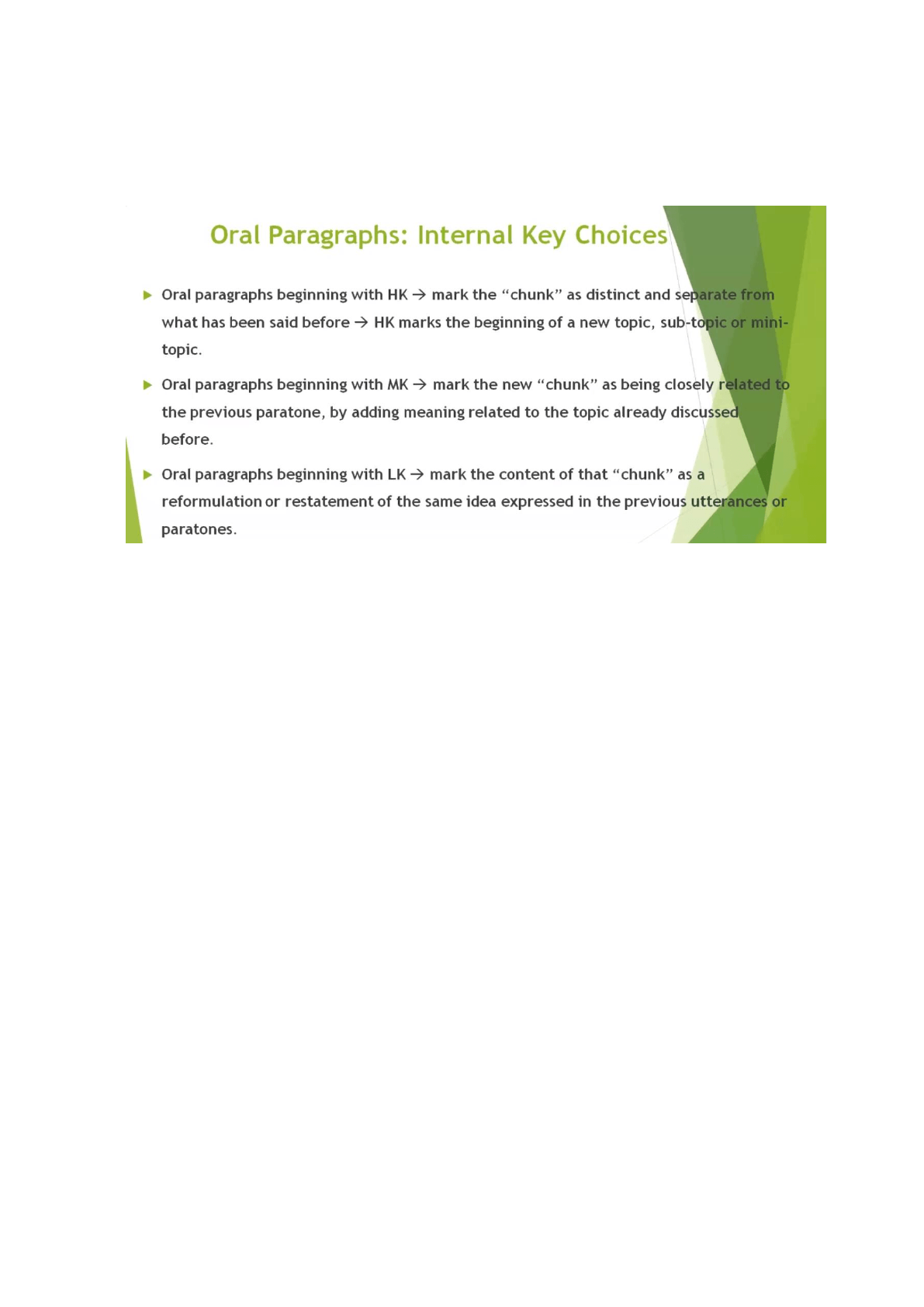
HK-> conveys contrastive meaning | disagreement | strong agreement
MK-> additive meaning: adding more information, building, expanding more context on a
certain idea.
LK-> equative meaning, when we paraphrase something.
aside comments
1. Withi th ton uni, wher d speaker mar ke?
2. Wh doe Coulthar stat tha ke i meaning choic?
3. Doe th speaker´ choic of ke pervad th whol ton uni? Wh?
LOW KEY
It is a meaningful choice that conveys different types of meanings in different contexts.
For example, Low key conveys equative meaning, which is the equivalent of something
that has been said before.
Low key may be used:
1. To convey sth similar to what has been said before. Paraphrase.
2. To make aside comments (“How shall I put it?” Mr. March text)
3. To show agreement in expressions like “hmm” “mmm”
Low key is lower in pitch, softer in volume, faster as regards speed of delivery.
It is a marked choice since interlocutors deviate from their usual communicative
behaviour.
Brazil says that the equative meaning of Low key pervades the whole tone unit even if it has
High termination or Mid termination in the same tone unit. That is to say that the meaning of
low key pervades through the whole tone unit.
High Key
High key is produced when we depart from the norm and we raise the height of our
voice on the onset syllable.
The more instances of high key we produce, the angrier and annoyed we may
sound.

Conveys contrastive meaning | disagreement Strong agreement
Stres
It is a linguistic property of words, particularly when thought out of context
Features of stress: stress have four properties
1. Pitch movement: movement of the voice, which can be heard as ranging from
high to low. Stress syllables sound louder than the other syllables in a word.
2. Loudness: the intensity with which the syllable that carries the primary stress
is pronounced.
3. Length: It is the duration of sound in a stressed syllable, especially vowel
sounds.
4. Quality: stressed syllables carry any of the vowels of English, except reduced
or weak vowel sounds.
Level of stres
1. Primary stress: the last stressed syllable in a word and pitch movement
initiator.
2. Secondary stress: it has potential to be a pitch movement initiator in
connected speech, when we drop the first stress in stress-shift.
3. Tertiary stress: it is strong by nature, it doesn’t contain weak vowel sounds
4. Unstressed syllables: it contains weak vowel sounds or syllabic consonants.
Distinction between accent and prominence.
For brazil, accent is the attribute that invariably distinguishes the marked syllable from the
unmarked syllables in a word, or, in a sentence, distinguishes the lexical items from others.
For example: relation // re LA tion // // TOM is the BEST BOY in the CLASS//
However, when we say //Tom IS the best boy in class// we are not accenting “is,” we are
making it prominent. Thus prominence is the name of a property that is given to a word by
the speaker in virtue of its function inside the tone unit. This property is not inherent to the
word.
Terminatio
Termination is realized on the tonic syllable, which also carries the tone or pitch movement.
Across speakers, termination regulates conversational behaviour, because it sets
constraints on the interlocutor. This means that the termination chosen to terminate one
tone, projects expectations about the pitch height or key the interlocutor may choose
to answer with.
The interlocutor may choose to comply with these expectations, in that case we talk
about pitch concord. But, if the interlocutor does not comply with those expectations, we talk
about pitch discrepancy.

High termination expects high key
Mid termination expects mid key
Low termination brings the pitch sequence to an end and it does not present any
expectations as it brings all constraints to an end.
As regards low termination, the interlocutor can freely choose to start with
● High key -> new topic or minitopic
● Mid Key -> same topic
● Low key-> acknowledge receipt of information
We call it an instance of pitch concord when the expectations set up termination are met.
When these expectations are not met by the other interlocutor, an instance of pitch
discrepancy is presented.
As low termination does not set up any expectations when cannot talk neither of pitch
concord nor of pitch discrepancy.
Pitc sequenc
A pitch sequence is a higher order phonological unit which is above the tone unit. We mark
the end of a pitch sequence using ///.
It is a unit of indefinite length, which begins immediately after a tone unit with low termination
and includes all succeeding tone units until the next one with low termination.
Its end tends to coincide with the end of a topic.
They have great communicative value because they help speakers with topic management.
Pat says: “are you happy with your new job?” using mid key and mid termination. Ann
answers using high key, expressing a contrast.”I HATE it”. This is a case of pitch
discrepancy, as mid termination expects the use of mid key by the interlocutor. Thus, Pat
expectations are not fulfilled. In the following part, Ann goes on adding information in mid
key and finishes with mid termination.
In this case, we can say that there is an instance of pitch concord as Ann uses mid
termination, which expects mid key. And Pat uses mid key, so the expectations are fulfilled.
There is low termination there, which passes the floor to the other speaker. Remember that
low termination does not project any expectations about the key the other speaker should
use, as it projects no expectations and it brings all constraints to an end. So we can’t mark
neither pitch concord nor discrepancy. The interlocutor can freely choose to start with any
key.
Use pression
1. project expectations
2. fulfill expectations
3. there is an instance of pitch concord/discrepancy

4. the speaker selects (high/mid/low) (key/ termination)
5. comply with expectations
6. yield/pass the floor
7. bring the topic to an end
Can you identify the beginning of a new topic or subtopic? How can you tell?
Can you mark instances of additive, contrastive and equative meaning in dierent
dialogues?
Can you identify when a topic or conversation comes to a close?
Short oral presentations
Revisio of importan concept
Key is pitch high realised on the onset syllable. When we speak about key, we
usually think about three dierent meanings: High key → contrastive
meaning; mid key → additive meaning; and low key → equative meaning.
Termination is pitch high realised on the tonic syllable in a tone unit.
Key and termination are very important phonological strategies that help us
guide our audiences more eectively.
■ Across speakers, termination regulates conversational behaviour. Because
high, mid and low termination play dierent roles in a conversation.
■ We usually organise oral presentations by resorting to paratones or oral
paragraphs, which start with high key and finish with low termination.
Why does termination play a fundamental role in communication?
● LT signals the end of a topic, sub-topic, mini-topic or an aspect of the
same topic. In short presentations, instances of LT allow
interlocutors to phonologically organise discourse because it marks
the boundaries of pitch sequence or a paratone.
● Boundaries between paragraphs are usually accompanied by other
phonological cues. For example, a long pause or we can produce
laringelization.
Oral presentation
By changing pitch level, we can segment our discourse into dierent
paratones or oral paragraphs→ guidance for our audience.
Paratones start with high key and finish with low termination.
Interlocutors structure monologues phonologically by resorting to
paratones, or oral paragraphs. Which are instances of pitch
sequences. They start right after a low termination with high key and
go on till the following instance of low termination.
Paratones have indefinite length.
Ke concept
● PARATONE OR ORAL PARAGRAPHS
● TERMINATION
● REFORMULATION
● BOUNDARIES
● PITCH SEQUENCE
Use pression
● REGULATES CONVERSATIONAL BEHAVIOUR
● PHONOLOGICALLY ORGANIZE DISCOURSE
● MARK/ SIGNAL
● SEGMENT DISCOURSE
The choice of high key at the beginning of an oral paragraph signals the start of a
new topic or subtopic. true
When speakers make the choice of starting his/her pitch sequence with mid key,
they decide to bring the topic to an end. false
If a speaker selects a low key to start her/his tone unit, the information provided
in the new tone unit is the reformulation or restatement of the previous one. true

Resumen primer parcial.pdf
 Estamos procesando este archivo...
 Lamentablemente la previsualización de este archivo no está disponible. De todas maneras puedes descargarlo y ver si te es útil.
Descargar
Estamos procesando este archivo...
Lamentablemente la previsualización de este archivo no está disponible. De todas maneras puedes descargarlo y ver si te es útil.